
CRNA Mock Interview Guide
A strong CRNA interview is less about memorizing perfect lines and more about showing safe, structured clinical thinking under pressure. Whether you are preparing for a CRNA program interview or a nurse anesthetist role, interviewers evaluate how you reason, communicate, and protect patient outcomes.
Many candidates review sample questions once, then assume their clinical background will carry them through. In practice, success often comes down to how clearly you explain your decisions in high-stakes moments. A focused mock interview routine helps your answers sound organized, concise, and credible.
This guide gives you a practical system: high-value question categories, repeatable answer frameworks, common mistakes to avoid, and a 4-week rehearsal plan you can start now.
Why a CRNA Interview Is Different From Other Nursing Interviews
A standard nursing interview may focus on unit fit, workflow, and core patient care. A CRNA interview usually goes deeper into critical thinking, physiology application, autonomy, and risk management. Interviewers want to see both competence and composure.
In a typical CRNA interview simulation, you should expect pressure-testing in these areas:
- Clinical judgment in ambiguous or deteriorating patient conditions
- Prioritization during time-sensitive anesthesia decisions
- Communication with surgeons, anesthesiologists, and nursing teams
- Ethical reasoning and patient advocacy in complex situations
- Self-awareness, resilience, and commitment to lifelong learning
The goal is not to sound perfect. The goal is to show a safe, structured thought process. That mindset should shape every interview practice session you run.
What Interviewers Are Really Looking For
Understanding interviewer intent gives you an edge. Most CRNA panels are not simply collecting right or wrong answers. They are assessing whether they can trust your decision-making in high-risk clinical environments.
Here is what strong candidates consistently demonstrate:
- Safety-first reasoning: They explain how they protect patient outcomes before discussing speed or convenience.
- Clear clinical logic: They connect assessment findings to interventions in a step-by-step way.
- Situational awareness: They show how they monitor changes, anticipate complications, and escalate early.
- Team collaboration: They describe concise handoffs, closed-loop communication, and respect for interdisciplinary roles.
- Professional maturity: They can discuss mistakes or difficult cases with accountability and reflection.
After each mock session, score yourself on these five traits. You will improve faster than by only counting how many questions you completed.
Most Common CRNA Mock Interview Question Categories
Your preparation should include a balanced mix of question types. If you only rehearse technical answers, behavioral questions can still derail your interview.
1) Clinical Scenario Questions
These prompts test how you process evolving patient conditions. Example: "A patient develops sudden hypotension after induction. Walk me through your immediate response."
- Speed and order of assessment
- Differential thinking
- Safe intervention sequence
- Communication with the OR team
2) Behavioral Questions
These questions reveal judgment, leadership, and professionalism. Example: "Tell me about a time you managed conflict during a high-acuity case."
- Emotional control under stress
- Collaboration skills
- Accountability and learning mindset
3) Motivation and Fit Questions
You may hear: "Why CRNA?" or "Why this program/facility?" What matters is specific, credible motivation, not generic statements.
4) Ethics and Patient Advocacy Questions
Example: "How would you respond if you believed a patient safety concern was being overlooked?" Panel members look for courage, professionalism, and structured escalation.
5) Technical Knowledge Validation
You may be asked focused questions on pharmacology, physiology, airway management, or monitoring interpretation. A strong interview prep routine includes timed technical rounds so you practice concise, clinically grounded responses.
A Simple Framework for Stronger Answers
One of the biggest interview risks is disorganized talking. Use a repeatable framework to keep answers focused and high quality.
For scenario questions, try A-C-T-S:
- A - Assess: What data do you gather first?
- C - Consider: What are your likely causes or priorities?
- T - Treat: What intervention do you initiate and why?
- S - Share: How do you communicate and monitor next steps?
For behavioral questions, use S-T-A-R-R:
- Situation
- Task
- Action
- Result
- Reflection (what you learned and how it changed your practice)
During each mock interview, ask your reviewer to grade your structure from 1-5. Over time, consistent structure builds confidence and reduces anxiety-driven rambling.
12 High-Value Questions to Practice
Use these prompts to build your weekly rehearsal set:
- Why did you choose the CRNA path?
- Tell us about a high-pressure case and how you managed it.
- Describe a time your initial assessment was wrong. What happened next?
- How do you prioritize when multiple urgent tasks compete at once?
- Walk us through your approach to preventing perioperative complications.
- Describe a disagreement with a provider and how you handled it.
- How do you prepare for a complex case before entering the OR?
- Tell us about a patient safety concern you escalated.
- What are your strengths, and where are you still developing?
- How do you maintain composure during critical events?
- Why are you interested in this specific program or facility?
- Where do you see your CRNA career in five years?
For each question, write bullet-point anchors, not full scripts. In interview practice, memorized wording often sounds stiff, while anchored responses sound natural and credible.
Sample Answer: Behavioral Question
Question: "Tell me about a time you had to communicate urgent concerns to a surgeon or senior provider."
Sample structure:
- Situation: During a high-risk abdominal case, patient pressure trended downward with signs of poor perfusion.
- Task: I needed to communicate concern quickly, ensure alignment, and support immediate stabilization.
- Action: I gave a concise update using closed-loop communication, stated trend data, proposed immediate checks and interventions, and confirmed team responsibilities.
- Result: The team aligned rapidly, hemodynamics stabilized, and the case continued safely.
- Reflection: I learned that brief, data-driven communication prevents delays in critical moments.
You can adapt this method for many prompts in your interview practice library.
Sample Answer: Clinical Scenario Question
Question: "A patient desaturates shortly after airway intervention. What do you do first?"
A strong response is structured and safety-oriented:
- Confirm desaturation trend and verify monitor reliability.
- Perform immediate airway assessment and support oxygenation.
- Consider likely causes (equipment issue, airway obstruction, bronchospasm, displacement, etc.).
- Initiate prioritized interventions while continuing reassessment.
- Communicate status and next actions clearly to the team.
- Document and debrief after stabilization to reinforce learning.
Notice the difference between listing random facts and explaining sequential clinical reasoning. High-quality mock interview prep trains this sequence until it becomes automatic.
Common Mistakes That Hurt CRNA Candidates
Even strong clinicians can underperform in interviews due to avoidable habits:
- Overly long answers: Going off-topic can make you seem uncertain.
- Unclear decision logic: Interviewers need to hear your reasoning path.
- Too little reflection: Not discussing lessons learned weakens maturity signals.
- Generic motivation: "I love helping people" is not enough without specific evidence.
- No rehearsal under pressure: Knowledge alone does not equal interview readiness.
Fix these issues with deliberate practice. Record your sessions, then review clarity, pacing, structure, and confidence markers.
Your 4-Week CRNA Mock Interview Plan
A repeatable sprint keeps preparation realistic and measurable.
Week 1: Foundation and Story Building
- Define your top 8-10 experiences relevant to CRNA competencies.
- Build STAR-R notes for leadership, conflict, safety, and resilience.
- Run one baseline mock interview and identify weak areas.
Week 2: Clinical Scenario Depth
- Practice daily scenario prompts with A-C-T-S framework.
- Focus on concise prioritization and communication language.
- Re-run missed questions from Week 1.
Week 3: Full-Length Simulation
- Simulate complete interview sessions (45-60 minutes).
- Mix behavioral, technical, and ethics prompts.
- Use timed responses to improve confidence under pressure.
Week 4: Performance Tuning
- Refine top answers for clarity and brevity.
- Prepare thoughtful questions for interviewers.
- Reduce cramming; focus on calm delivery and consistency.
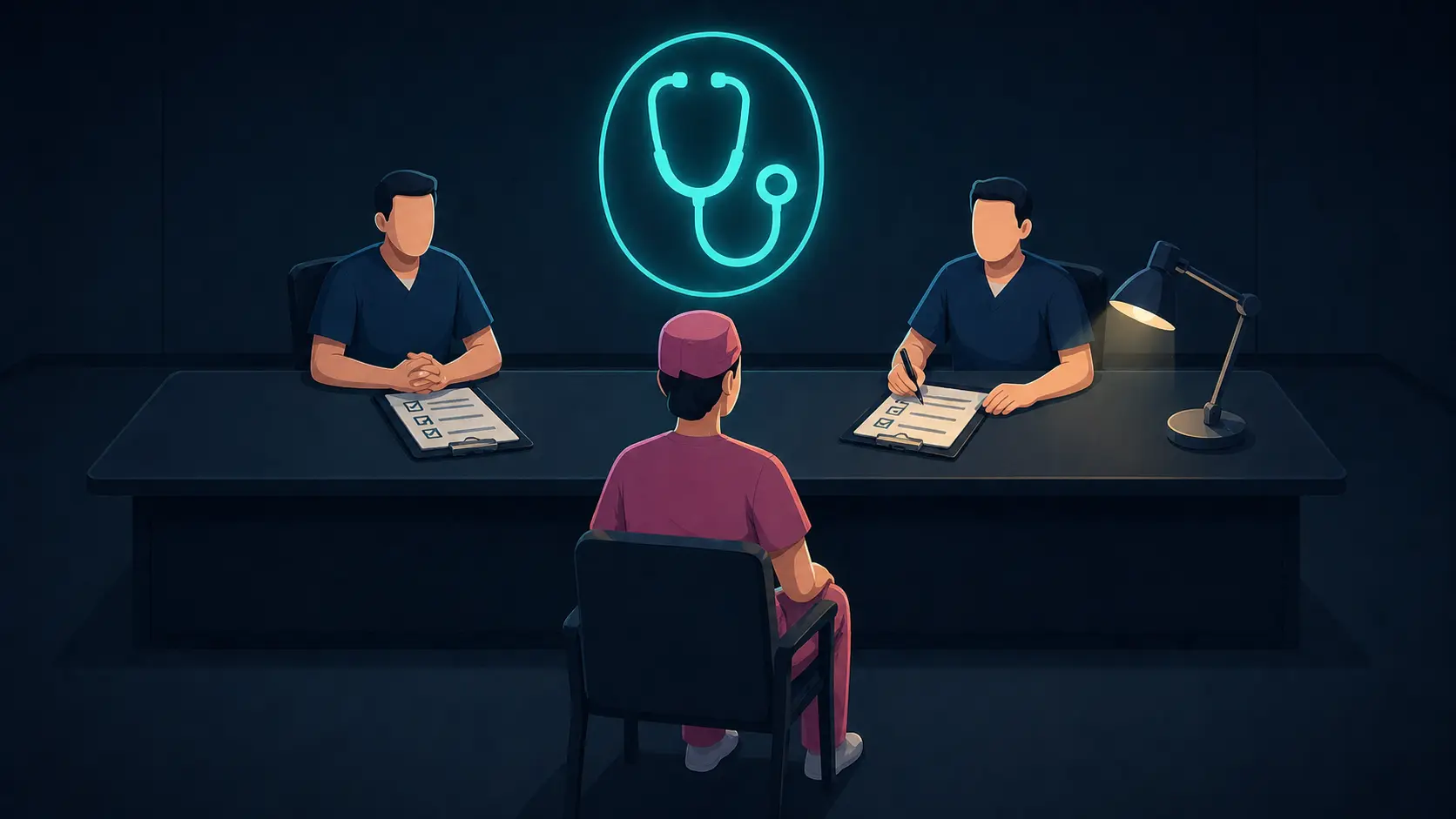
If possible, include at least one external reviewer for objective feedback. Pair this with online mock interview simulation to practice realistic pacing and response quality. You can also explore more interview preparation resources to deepen weak areas between sessions.
Questions You Should Ask the Interview Panel
Great candidates ask focused questions that show maturity:
- "What qualities distinguish top-performing CRNAs in your program/team?"
- "How are new CRNAs supported during transition and onboarding?"
- "What patient safety priorities are most important in your current workflow?"
- "How is feedback delivered after complex cases or critical events?"
These questions signal that you care about fit, standards, and long-term growth.
How to Practice Before an Interview
Practice should mirror real pressure, not passive reading. Schedule short, high-quality sessions where you answer mixed prompts out loud, receive feedback, and immediately revise weak responses. The most effective CRNA interview prep routines combine behavioral storytelling, scenario reasoning, and concise technical explanations.
For candidates who want faster iteration, using practice interview with AI helps identify patterns like overexplaining, weak structure, or poor transitions. This rapid feedback loop is especially useful when you are preparing on a tight timeline.
Conclusion
A successful CRNA mock interview is not about memorizing perfect lines. It is about building a dependable framework for clear, safe, and confident communication. Focus on what interviewers actually evaluate: clinical judgment, structured thinking, collaboration, and professionalism.
Start with one full mock this week, score your performance honestly, and improve one skill at a time. With consistent rehearsal, your preparation can turn interview stress into focused readiness and stronger outcomes.